Last updated: October 17, 2026. Plan prices checked on Claude pricing and the vendors’ plan pages between October 15 and 17, 2026. My own numbers come from my billing pages and a CSV export of my DeepSeek usage, not from estimates.
Most “AI stack cost” posts list subscriptions and stop there. The subscriptions are the easy part: they’re flat, and you know the number before the month starts. The part that surprises people is the one line that scales with usage, and the fact that the cheapest-looking option can turn into the most expensive one if you use it the wrong way.
So this post does two things. First, three budgets you can copy: $0, about $40, and about $150 a month. Second, my actual bill for the last 30 days, with screenshots, including one usage-based line that processed 5.3 billion tokens for about $40.
TL;DR: three budgets
| Budget | What you get | Monthly | Who it’s for |
|---|---|---|---|
| $0 | Open-source agent (OpenCode, Cline or Aider) + a local model, free hosting tiers | $0 plus hardware | Learning, side projects, privacy-first |
| ~$40 | One $20 coding plan + one $20 second opinion, or one plan + a cheap API | $40 | Most people who ship every week |
| ~$150 | One heavy plan ($100) + a second agent ($20) + API budget for your product | $120 to $150 | Daily heavy agent use, AI features in your product |
My own setup lands at about $110 a month: $70 in flat subscriptions plus about $40 of API usage. I’ll break that down below.
One rule before the details: pay for the model, not the UI. Editors, terminals and agent harnesses are mostly free now. The money goes to whoever runs the model, either as a subscription with limits or as per-token API billing.
The $0 stack (free tiers + open source)
A truly $0 stack exists, but you pay in time instead of money.
- Agent: OpenCode, Cline or Aider. All three are free to use and let you bring your own model.
- Model: a local model through Ollama or LM Studio. No API bill, and your code never leaves your machine.
- Hosting: Vercel Hobby is $0 but meant for personal, non-commercial projects. Supabase Free gives you 500 MB of database and pauses a project after a week of inactivity, which is fine for a prototype and bad for anything users depend on.
- Managed free tiers: Claude’s Free plan does not include Claude Code. Cursor Free has limited agent usage. Codex has a free lane in the desktop app, subject to rollout. Useful for trying things, not for a week of real work.
Pitfall: local models are real, but they’re weaker on multi-file refactors, and Ollama’s default context window is small enough to silently cut off files. If you go this route, raise the context length first (my free alternatives guide has the exact commands), and keep your expectations at “good intern,” not “senior engineer.”
When to leave the $0 stack: the first week you spend more time babysitting the agent than you’d spend earning $20.
The $40 stack (the default for most)
This is the budget I’d recommend to most solo builders who ship weekly. Two patterns work:
Pattern A: builder + reviewer ($40). One $20 plan that does the heavy lifting (Claude Pro for Claude Code, or ChatGPT Plus for Codex) and a second $20 plan from a different vendor that reviews the work. Two different models catch different mistakes. Both tools can read the same AGENTS.md, so switching between them costs nothing. The full setup is in my Claude Code vs Codex vs Cursor comparison.
Pattern B: one plan + a cheap API (about $20 to $40). One $20 plan for the hard thinking, and an open-source agent or Claude Code pointed at a cheap API model for the long, boring loops: tests, docs, boilerplate, refactors you can verify with a test run.
For Pattern B, the cheapest option I’ve found is DeepSeek. To be clear, it’s not the smartest model on the market. It is, by a wide margin, the cheapest one I’ve used for agent loops, and the next section shows what that looks like on a real bill.
Here’s what $20 buys at each vendor right now:
| $20-ish plan | Coding agent included | What the limits look like |
|---|---|---|
| Claude Pro ($20, or $17/mo billed annually) | Claude Code | Rolling 5-hour sessions plus weekly limits, shared with Claude chat |
| ChatGPT Plus ($20) | Codex | Estimated messages per 5 hours, varies a lot by model |
| Grok Premium ($30) | Cursor’s own-model pool, Grok apps | One weekly pool shared across Cursor and Grok |
| Google AI Pro ($20) | Gemini apps and Gemini CLI | Check Google’s plan page; limits vary by feature |
The $150 stack (when it pays back)
The $150 tier is usually one heavy plan plus one cheap second opinion:
- Claude Max 5x ($100) + ChatGPT Plus ($20) = $120. Heavy builder plus independent reviewer.
- ChatGPT Pro ($100 and up) + a $20 plan. Same idea, OpenAI as the main agent.
- Add $10 to $30 of API budget if your product calls an LLM. This is a different bill from your coding tools, and many founders forget to budget for it.
It pays back when you’re blocked by limits several times a week during work you’d otherwise be paid for. If you hit a limit once a week on a Sunday side project, it doesn’t.
Is Claude Max worth it? A decision table
Claude Max starts at $100 a month (5x Pro usage per session) and goes to $200 (20x). It also comes with $100 or $200 a month in Claude Platform API credits. Read that part carefully: per Anthropic’s help docs, those credits are for the API, the Agent SDK and your own apps. They don’t pay for interactive Claude Code or extra usage.
| Your situation | Verdict |
|---|---|
| You hit the Pro 5-hour limit a few times a month | Stay on Pro. Fix your context first (15 ways to cut Claude Code token usage) |
| You hit it most workdays and wait an hour or more | Max 5x ($100) pays for itself fast |
| Your product calls the Claude API and you’d spend $100+ there anyway | Max 5x is close to free coding, because the API credits offset your product bill |
| You run parallel agents all day, every day | Max 20x ($200) |
| You mostly chat, plan and write, and code an hour a day | Pro, or a $20 plan from another vendor |
| You’re limit-blocked but money is tight | Keep Pro and move the boring loops to a cheap API model (Pattern B above) |
A personal note: I don’t pay for Claude right now. I run Claude Code against DeepSeek’s API instead, alongside the flat subscriptions below. That’s a budget choice, not a quality claim.
My actual bills (screenshots)
Here’s everything I pay for AI, as of October 17, 2026:
| Line | Type | Monthly |
|---|---|---|
| ChatGPT Plus | Flat subscription | $20 |
| Google AI Pro | Flat subscription | $20 |
| Grok Premium | Flat subscription | $30 |
| DeepSeek API | Pay per token | about $40 (¥266.16 in the last 30 days) |
| Total | about $110 |
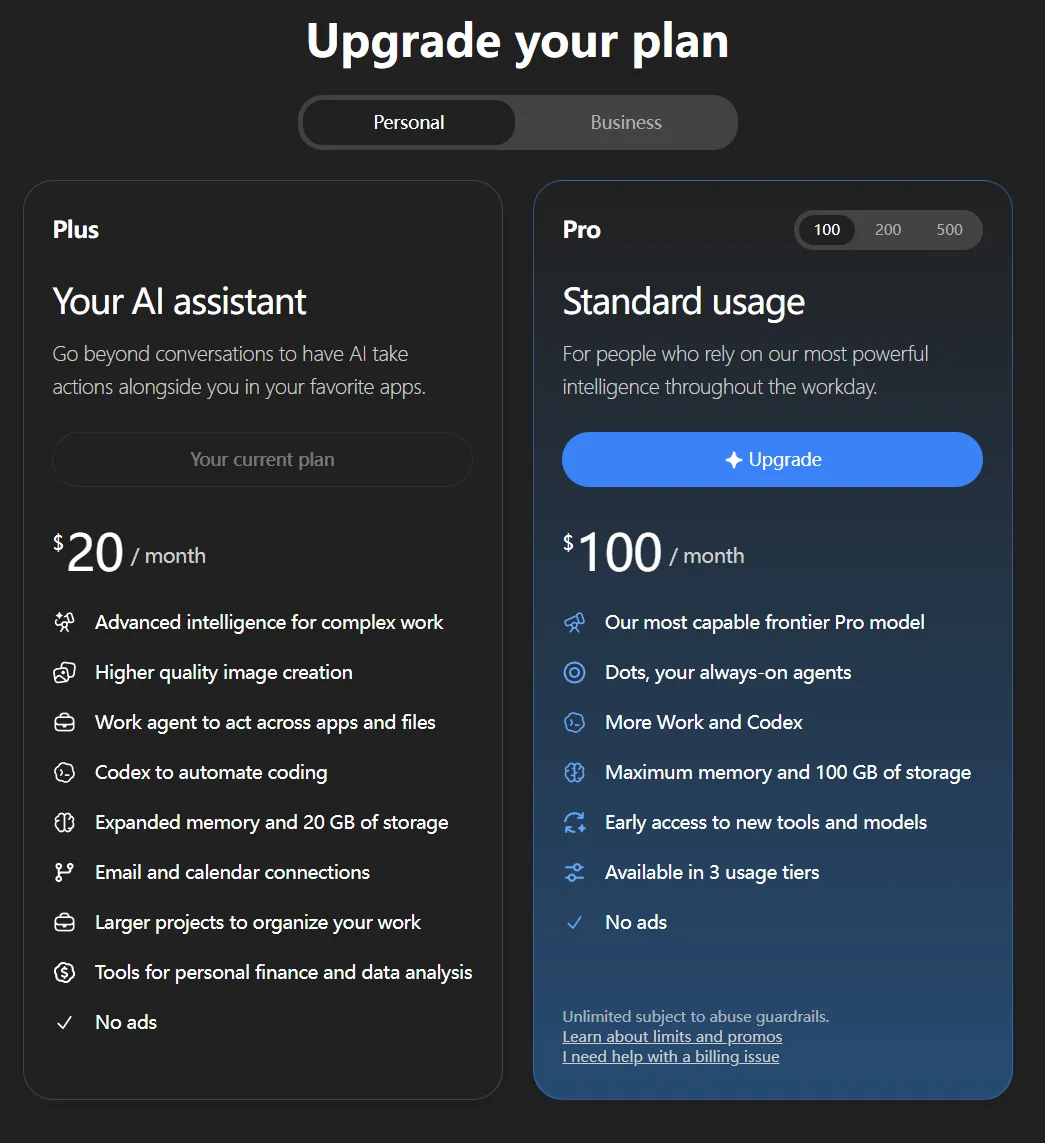

I only added Google AI Pro on October 12, so I’m not going to pretend I have a verdict on it yet.
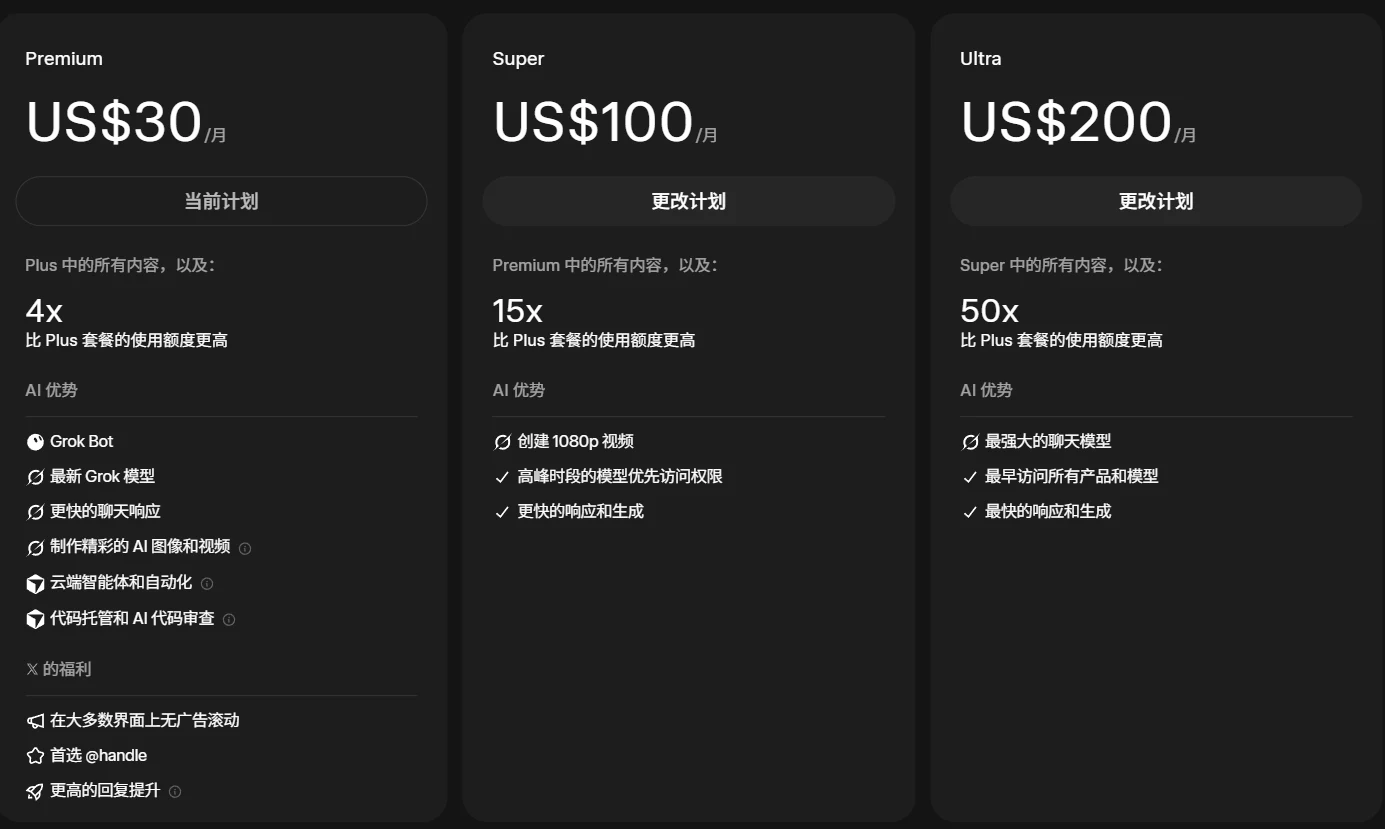
The interesting line: 5.3 billion tokens for about $40
Three of the four lines are flat. The fourth, DeepSeek, is the only one that moves with usage, and it’s the one people usually fear. Here’s my dashboard for September 18 to October 17:
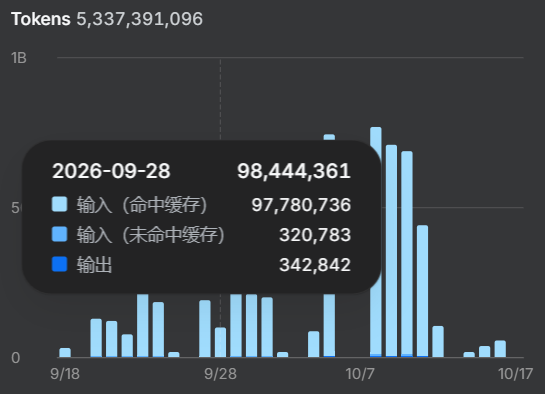
From my usage export for those 30 days, all on a single model (deepseek-flash):
- Requests: 27,767 across a few tools
- Tokens: 5,337,391,096 in total
- Cost: ¥266.16, about $40 at 6.70 yuan to the dollar
- Per request: about ¥0.01, roughly a seventh of a US cent
The breakdown is where it gets useful:
| Token type | Share of tokens | Share of the bill |
|---|---|---|
| Input, cache hit | 98.8% | 44% |
| Input, cache miss | 0.75% | 17% |
| Output | 0.43% | 39% |
Two lessons from that table.
1. Cache hits are the whole story. Cache-hit input costs 1/50 of fresh input. If those same 5.3 billion tokens had all been billed as fresh input, the list price would have been about $800 at off-peak rates, or about $1,600 at peak. I paid about $40 because almost everything an agent sends is the same prefix again: system prompt, tool definitions, CLAUDE.md or AGENTS.md, and the files already in context. The average request carried about 192k tokens, and nearly all of it was a re-send.
2. Output is tiny in volume and big in cost. Less than half a percent of my tokens were output, but they made up 39% of the bill. If you want to cut an API bill, asking the agent for shorter answers and diffs instead of full-file rewrites does more than trimming your prompt.
Bonus: timing matters. DeepSeek charges half price outside its peak hours (peak is 01:00 to 04:00 and 06:00 to 10:00 UTC on weekdays, and weekends are entirely off-peak). Only about 12% of my tokens landed in peak hours, so most of my bill was already at the half-price rate.
How to keep your cache hit rate high
These habits are what keep a usage-based line cheap, whichever provider you use:
- Don’t edit your instruction files mid-session. Changing anything near the start of the prompt breaks the cache for everything after it.
- Keep your tool list stable. Adding or removing MCP servers mid-session changes the prefix too.
- Start fresh sessions for unrelated tasks instead of dragging a giant context around, and
/compactbefore it balloons. - Ask for diffs, not full files, to keep output tokens down.
Copy-paste this into your project instructions if you run an agent on a pay-per-token API:
## Cost rules
- Reply with minimal diffs, never full-file rewrites unless asked.
- Don't restate the plan or the code I just gave you.
- Summaries: 5 bullets max.
- If a task needs more than ~20 files in context, stop and propose a narrower plan first.
FAQ
How much does Claude Code cost per month?
Claude Code is included with Claude Pro ($20 a month, or $17 a month billed annually) and Max ($100 for 5x, $200 for 20x). It isn’t on the Free plan. You can also run it on pay-as-you-go API credits, and it can be pointed at other providers’ APIs, which is how I use it.
Is it cheaper to use the API or a subscription?
It depends on your cache hit rate and how much output you generate. Agent workloads with stable context are cheap on APIs with good cache pricing. Chat-heavy work with long answers is usually cheaper on a flat plan. Check your own usage export for a week before deciding.
Do I need Cursor if I have Claude Code or Codex?
No. You can run Claude Code or Codex in VS Code or a terminal for free. Pay for Cursor if you want its own models or its editor features, not as a requirement.
What’s the cheapest setup that’s still good?
One $20 plan for the hard problems, plus a cheap API model for the long loops. It’s the setup I’d start with if I were rebuilding from scratch. For setup steps, see the $0 and budget setups in my free alternatives guide.
How often do these prices change?
Constantly. Several vendors changed plans in the last month alone. The “Last updated” date at the top tells you when I last checked these numbers against the vendors’ pricing pages.
If you’re putting together the rest of your workflow, start from my complete AI workflow for indie products, and if you’ve never shipped code before, read Claude Code for non-developers first.
1 thought on “The Real Monthly Cost of an AI Indie Dev Stack in 2026: $0, $40 and $150 Setups”